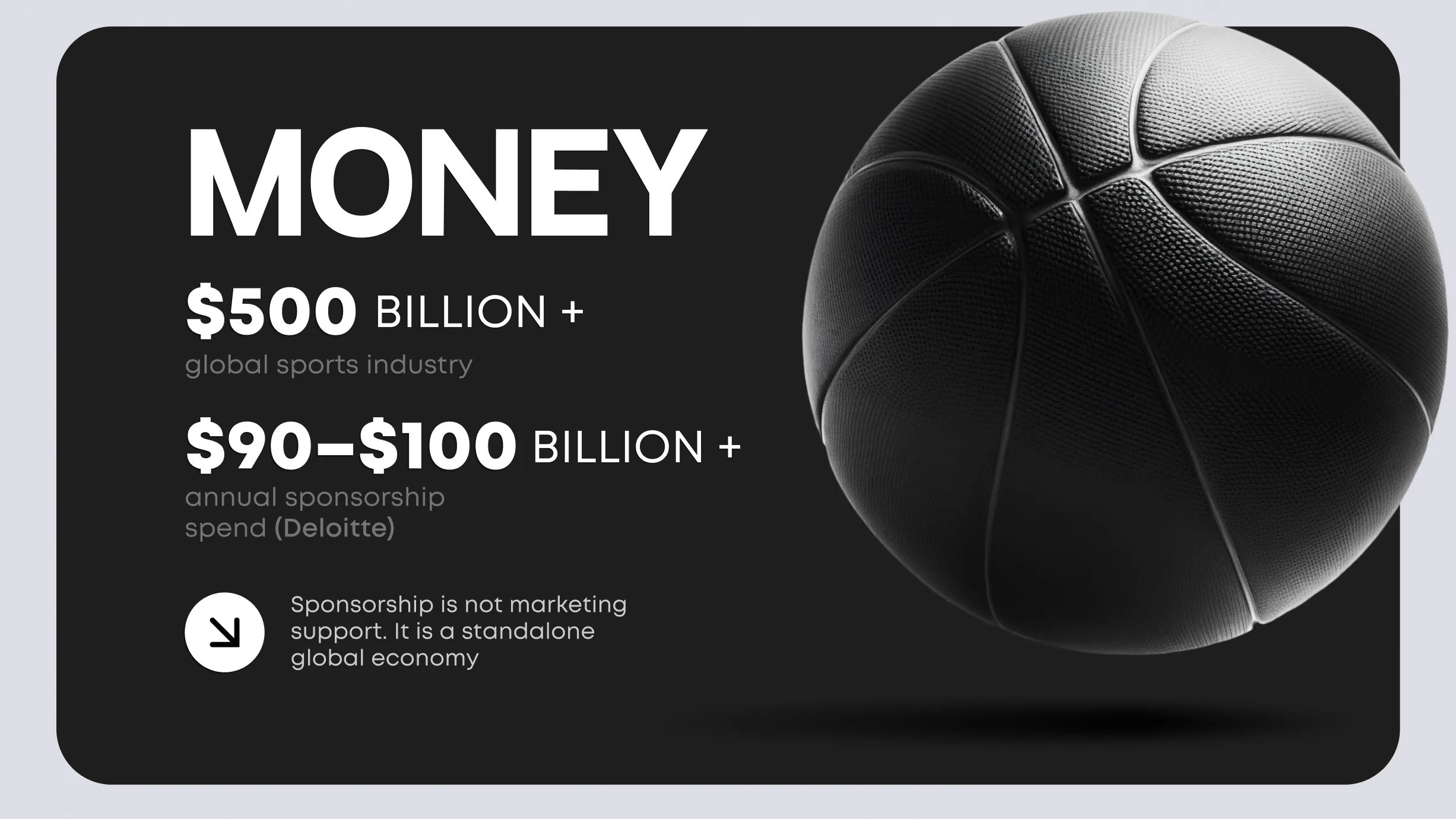
Sport is a $500B+ industry, and sponsorship alone is worth $90–100B a year. I don't see that as anyone's marketing budget. It's an economy of its own, and it keeps growing.
Most clubs still sell their piece of it the way they did in the nineties: a logo on the kit and a photo at the signing.
In 2020 stadiums were empty and sponsorship spend dropped. Then it came back and kept climbing. Research firms disagree on the exact size, with 2025 estimates anywhere from $92B to $114B, but they all have it growing 6–8% a year. Our own estimate puts it past $120B by 2028.
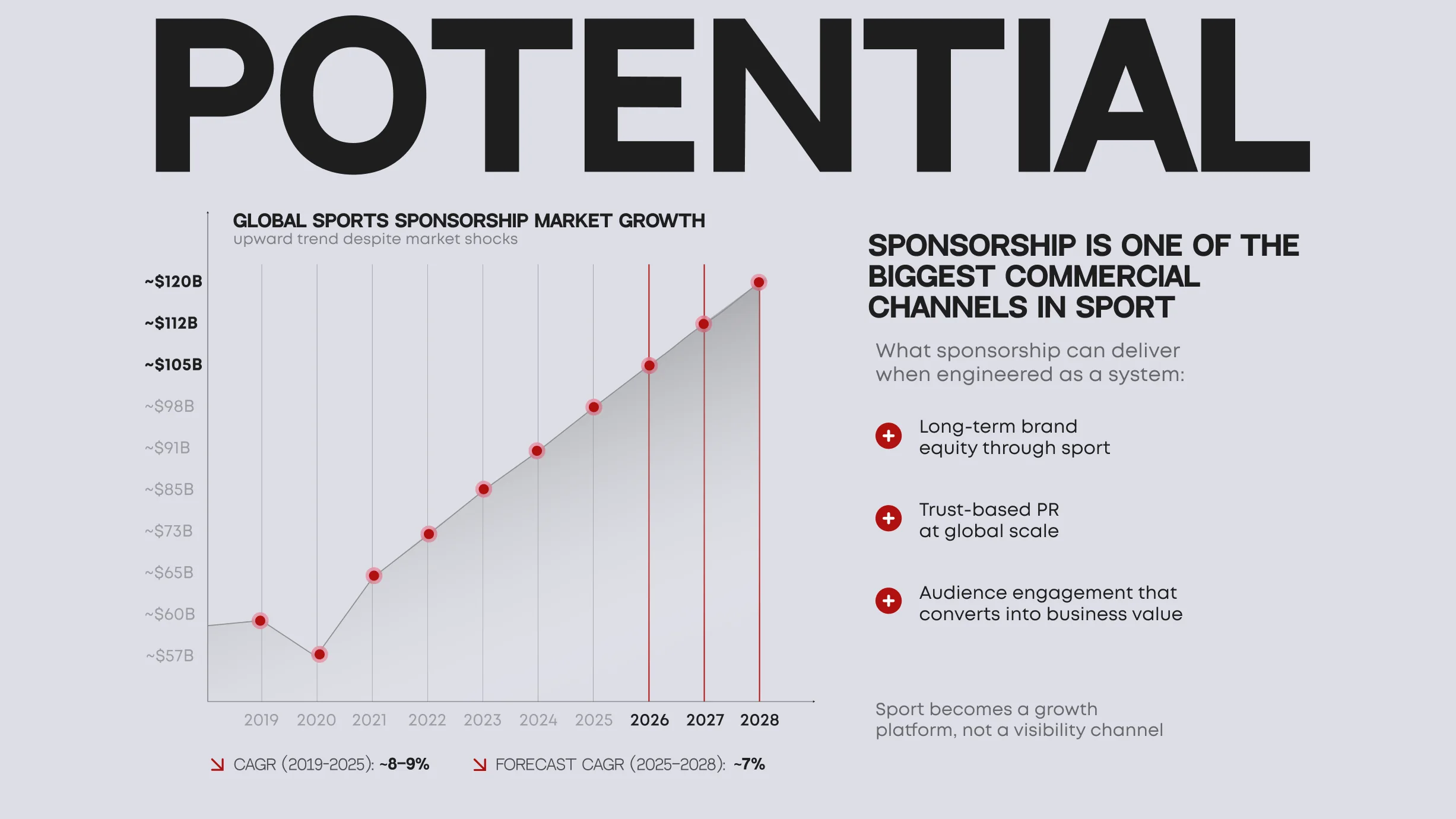
The growth will happen either way. Whether a club gets any of it depends on how it sells.
What brands pay for now
A logo buys a brand one season of visibility. A sponsorship built as a system gives it brand equity that grows year after year, and PR that people actually trust. Most of all, it gives the brand an audience it can sell to.
The biggest football clubs worked this out years ago. In the 2026 Deloitte Football Money League (season 2024/25), commercial revenue was the largest income stream for the world's top 20 clubs for the third year in a row, at 43% of the total. That's sponsorship, partnerships and merchandise, with broadcast rights and prize money left out. At the top 10 clubs it's close to 48%. Almost half their money comes from their name.
What's broken
The same three problems come up at almost every club outside the top five leagues.
First, sponsorship means a logo. The offer to a brand is a PDF price list with a stadium board, a shirt patch and a website banner on it. There's no access to the audience in it, no fan data, no content rights. Compare that with what McLaren, Aston Martin or Red Bull Racing sell their partners.
Second, nobody owns the process. Commercial work lands on the press office, or on management when they have a spare hour. A brand with a partnership budget ready to spend has nobody to talk to in business terms. If it's lucky, someone will talk to it in PR terms.
Third, there's no fan data. Without a supporter database, audience analytics and some way to measure return, a club can't prove what a package is worth. So it ends up selling emotion and Instagram reach.
A typical club outside Europe’s top five leagues has a full staff: players, coaches, administration, lawyers, finance. Its scouts will fly thousands of kilometres to watch one U-19 player. Nobody at the club is responsible for how much it earns on its own name.
Look at who pays to put a name on these leagues. Austria plays the ADMIRAL Bundesliga, Czechia the Chance Liga, Croatia the SuperSport HNL, Slovakia the Niké liga. All four title sponsors are betting companies. Not a coincidence. A diagnosis. The market has learned to sell one asset, a name in the broadcast, to one industry. And that industry is being pushed out of football: from this season, Premier League clubs no longer carry gambling brands on the front of their matchday shirts. A league that lives on betting money is one regulation away from losing it.
How McLaren did it
When Zak Brown became CEO of McLaren Racing in 2018, the car was one of the barest on the grid. He has described corporate partnership at the team back then as being at a record low. Today McLaren has more commercial partners than any other Formula 1 team, and its 2024 accounts show £530M (about $715M) in revenue.
The revenue is the result. What's worth copying is how Brown set up the commercial side. Partners buy different levels of access, from technology integration to content rights, and McLaren treats growing the partner's business as part of the deal. It works less like an ad sales desk and more like a B2B business that happens to run a racing team.
A football club won't build that in-house in one season. It needs a dedicated team, people who have closed deals before, access to brands, and time. That's why more and more teams in big sport outsource it.
It packages the club's sponsorship inventory into tiers (title, principal, official and technical partner), the way Formula 1 teams, MotoGP teams and Premier League clubs do. It negotiates with brands in business terms, signs the contracts and activates them. It builds a fan database so brands can see a measurable return. And it runs the partner portfolio so the brands on the shirt help each other rather than compete.
The five-second test
Before you hire another marketing manager, ask one question. Who at the club is responsible for how much we earn on our brand, and can they give you the number in five seconds?
If the answer is "nobody", "I don't know" or "one manager with no team", you don't have a commercial department. You have a logo looking for a sponsor. Is anyone actually looking?
This is the work DMNNT does for clubs. We package partnerships, negotiate with brands and sign the contract.
We start with the DMNNT Club Passport. It's an audit of the club's commercial assets, its audience and the brands that fit, plus a strategy with a number in it. After that we package the inventory, take it to brands, and run each deal through activation and reporting.
Write to ceo@dmnnt.pro with "Club Passport" in the subject line and tell us your club and league. We'll tell you how big your gap is.
Daria Rakitska
Founder & CEO, DMNNT